
Dade Projected Versus Actual Release
A projected date is an estimate or scheduled point based on the record as it stands. An actual release date records an event that already happened. Dade County Jail may calculate a local sentence end or process release after bond, a court order, time served, or a cleared hold. GDC keeps state-prison status and sentence fields. The Parole Board uses a Tentative Parole Month, or TPM, for final parole review.
None of those fields has the same meaning. A pretrial detainee has not yet received a sentence to calculate. Bond can be posted, revoked, or changed, and a judge may issue a new order. A sentenced county detainee may receive credit for confinement. A state prisoner may have sentence dates and a separate parole track. The final release may also be a transfer to another agency.
Find a Dade Projected Release Date
The first search should match the custody type. The GDC offender search is not Dade County Jail's roster. It covers Georgia state offenders. Dade's official jail resources page does not publish a working current roster or a projected-date field, so local dates require direct jail or court verification.
- Ask whether the person is in Dade County Jail, GDC custody, federal custody, or another agency's care.
- For Dade County Jail, contact detention at 706-657-2277 or 706-657-3233 and ask for the release date, release type, and any hold.
- Check the Dade court disposition or sentencing order for bond, sentence length, jail credit, probation, or an amended order.
- For state prison, use the official GDC offender search and compare the GDC ID, status, sentence fields, facility, and release fields.
- For parole timing, use the Board's TPM lookup, but treat the month as tentative.
- Confirm the latest result with the jail, court, GDC, or Board before relying on it.
A Dade jail release only proves departure from county custody. If the person transferred to GDC, that event is not community release. The Dade County released-inmate record guide covers the broader local search and records-request chain.
When contacting the jail, give the full name, date of birth if known, booking date, and charge or case number if available. Ask for the date and time, stated release reason, and destination. If staff cannot provide the record by phone, email jail@dadesheriff.com or make a focused Georgia Open Records Act request. The Act applies to existing records. It does not require the sheriff to predict a future release or create a new calculation.
Dade Jail Credit and Time Served
For a Dade County jail calculation, the sentence and court record come first. O.C.G.A. § 17-10-11 requires credit for each day spent in confinement for the offense. It includes pretrial confinement and certain posttrial confinement while awaiting appellate remittitur or transfer. That credit can make a sentence complete at sentencing or shorten the unserved balance.
Bond cases work differently. A person held before trial is not serving a final term with a fixed projected end. Release may occur when bond is posted and processed, when a judge changes the order, when the charge is dismissed, or when a hold clears. If another agency has lodged a detainer, the Dade release date may mark only the handoff. Ask the jail whether the exit was to the community or to a receiving agency.
Why Dade Release Dates Change
Release timing changes when the facts behind the calculation change. Some changes move a date forward. Others delay release or redirect the person to another custodian. The source of the change tells the reader which office can verify it.
| Factor | Possible effect | Record owner |
|---|---|---|
| Bond posted or revoked | Creates or removes a local release path | Dade jail and court |
| Jail credit corrected | Changes time remaining on a sentence | Court and jail |
| Amended court order | Changes sentence or release authority | Sentencing court |
| Detainer lodged or lifted | Delays community release or causes transfer | Jail and requesting agency |
| Program progress or misconduct | May advance, postpone, or cancel parole timing | GDC and Parole Board |
| Residence plan review | May delay a planned parole release | Parole Board |
Federal or immigration custody can also intervene. In that case, a person may disappear from the county system while remaining confined elsewhere. Search the receiving system instead of treating the missing Dade entry as proof of freedom.
Confirm Dade County Release Timing
Georgia VINE can add an alert layer while a person remains in a participating agency's custody. Search the correct person, compare the reporting agency and identifiers, then register for an offered phone, email, text, TTY, or in-app notice. A VINE message is useful for a custody change, but the jail, GDC, court, or Parole Board remains the source for the controlling record.
For Dade County Jail, request the release date and time, release reason, and destination. For a state offender, preserve the GDC ID and status fields, then confirm a release field with GDC Inmate Records and Information when needed. GDC directs written verification to P.O. Box 1529, Forsyth, GA 31029. The Georgia VINELink check guide explains search and alert registration in more detail.
Dade State Release Record Fields
A Dade case that led to state prison can remain visible in GDC after the county booking is gone. Search results may show a GDC ID, name, aliases, photo, current status, active facility, actual release date, maximum sentence or end-date fields, offense, sentence date, conviction county, case number, and movement details. The conviction county can connect a state record back to Dade.
| Current status | Helps distinguish active GDC custody from released or discharged status. |
|---|---|
| Actual release date | Records a past state-prison release when available. |
| Maximum sentence fields | Describe sentence limits, not a guaranteed day of release. |
| Conviction county and case | Connect the GDC record to the Dade court matter. |
GDC warns that its public data may not be complete and directs users to written verification. A current facility field means the person remains in state custody. It should not be read as a Dade County Jail location.
The actual release field is strongest for a past GDC event. A maximum sentence date marks an outer sentence point, but parole, earned incentives, court changes, and other rules can affect custody before that point. Conversely, another hold can prevent community release even after one sentence is satisfied. Read the status and movement fields together. If a result lists Dade as the conviction county, use the case number to obtain the sentencing order from the Dade clerk.
Georgia PIC and Dade Releases
GDC's Performance Incentive Credit program gives eligible state offenders a chance to reduce length of stay through satisfactory progress. GDC ties PIC to education, vocational work, treatment, work assignments, good conduct, and an individual reentry plan. The points follow a standard system. They do not apply as a blanket county-jail credit.
The Parole Board says eligible prisoners may have a TPM advanced by a few months for satisfactory program and work progress. Misconduct can have the opposite effect. The available source screenshot shows the state PIC explanation and can help a reader identify the official program page.
PIC is an incentive process for eligible state offenders, not a promise of a specific day. GDC uses an assessment to develop the reentry plan, and credits are tied to progress under that plan. The Board retains authority over parole decisions. Therefore, a program milestone can affect one part of the timing analysis without becoming the actual release date shown after custody ends.
View the official GDC PIC page before comparing its rules with a state offender's record.
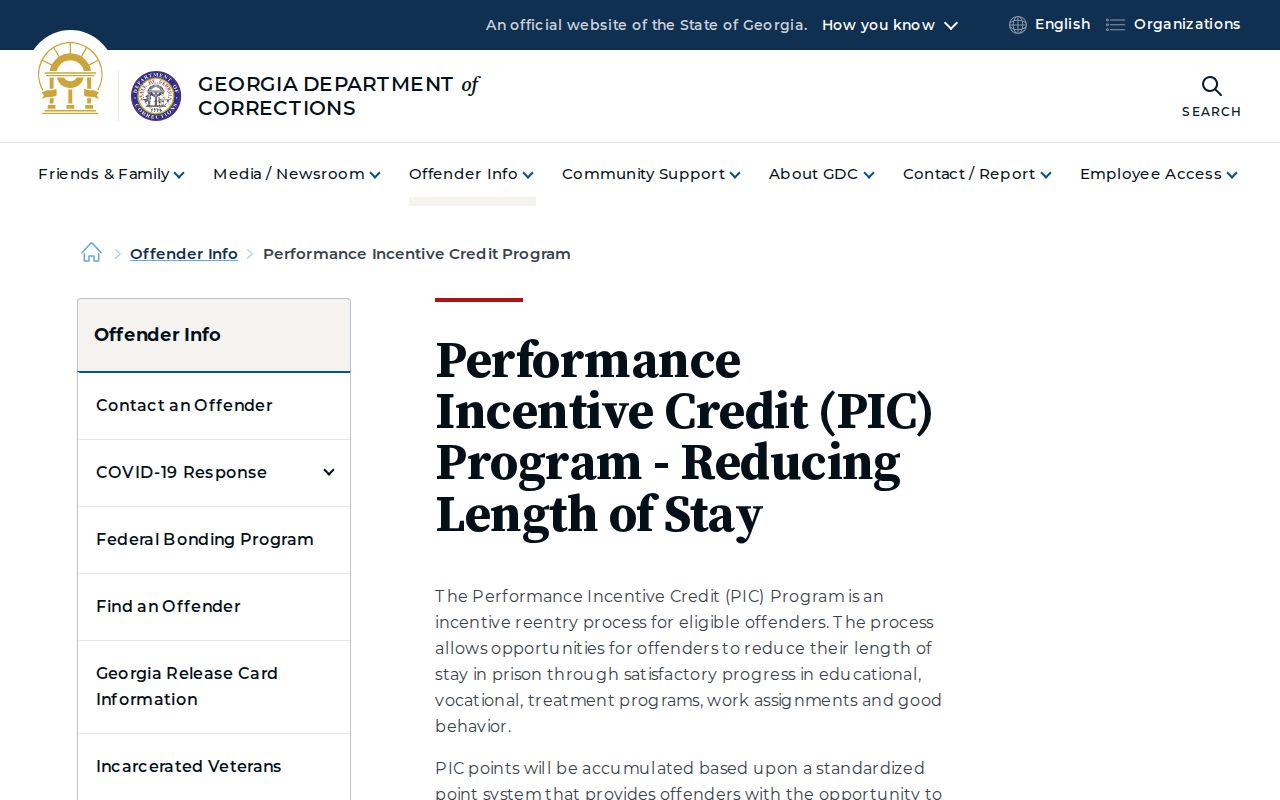
The image identifies the state program source. It does not calculate a date for an individual or show a Dade County Jail release.
Dade Parole Eligibility Is Not 85%
Georgia does not impose one universal rule that every offender serves 85 percent before release. O.C.G.A. § 42-9-45 generally makes a felony inmate eligible for consideration after nine months or one-third of the sentence, whichever is greater, subject to exceptions. The Board stresses that eligibility is not a grant and that few people receive parole at their first eligible point.
Some categories are ineligible. The Board identifies certain non-life serious violent felony sentences for crimes committed on or after January 1, 1995, fourth-or-more felony recidivists, and life without parole. Life sentences have separate rules. The guidelines also produce months-to-serve or percentage recommendations, but the Board may accept or reject them. It rejected a single across-the-board percentage approach because Georgia law requires more than offense severity alone.
The statute also sets different general eligibility floors. A misdemeanor inmate is generally eligible after six months or one-third of the sentence, whichever is greater. For aggregate sentences of at least twenty-one years, the statute uses seven years, subject to its exceptions. These are consideration points, not release dates. A Dade County reader should never subtract a simple percentage from the sentence and report the result as an official date.
Dade TPM Is Not Release
A Tentative Parole Month is the month in which the Board plans final review. If appropriate, it may then set a parole release date. Conduct, required counseling, program completion, and the residence plan can affect that decision. Reports of misconduct usually cause postponement or cancellation.
The TPM lookup accepts a six-digit inmate number, GDC ID, or personal data. Use it only for a person in the state parole process. Someone released straight from Dade County Jail on bond, time served, dismissal, or probation does not get a TPM for that local release. After a parole release, use the parolee search to check supervision status and the GDC record for state custody history.
A residence plan may be checked as the tentative month approaches. The Board can also reconsider and change a prior decision up to release. If a detainer exists, parole may be granted to that authority as a conditional transfer. In that case, the parole event does not mean the person entered the community. Confirm the receiving agency and then check its custody system.