
Dade County Booking Photo Records
A booking photograph documents appearance during an arrest-processing event. It is tied to that booking, not to a later finding in court. Release does not erase the underlying record. Yet public access is not the same as unrestricted disclosure. Georgia law places a specific limit on law-enforcement release when a photograph may be posted in a publication or on a website that charges for removing or deleting it.
That limit matters in Dade County because no official jail photo gallery was found. A requester should identify the exact person and booking, state a lawful records purpose, and allow the sheriff’s custodian to apply O.C.G.A. § 35-1-19 and any other valid exception. A released person also drops from a live custody view, when one exists, so a current roster is not a lasting photo archive.
- Booking photograph
- The image made during arrest and intake.
- Release
- The end of one agency’s custody, which may be community release or transfer.
- Record restriction
- A legal limit on access or disclosure, even when related records remain public.
Find Dade County Release Mugshots
The correct channel depends on custody type. A Dade County Jail image belongs to the sheriff’s booking record. A GDC photograph belongs to a state offender record. A registry image is limited to a person with a registration duty. VINELink may display agency-supplied identifying data, but it is primarily a custody and notification service. Commercial results may be stale, so they should never be treated as official proof.
| Channel | Photo? | Access |
|---|---|---|
| Dade jail roster | No published gallery found | Use the sheriff records route |
| Sheriff mobile app | No inmate-photo app found | Do not assume an app exists |
| Booking record request | Possible, subject to law | Ask Dade County Jail for the named booking |
| GDC offender search | If available | Search a person who entered state custody |
| Sex-offender registry | For registrants only | Use sheriff-linked registry access |
| Local news | Not established for Dade reports | Use only as a lead |
The table separates sources that are often confused. A GDC photo is not a Dade County Jail mugshot gallery. A registry image does not cover all released inmates. An arrest report proves neither release nor the final outcome of the case.
Georgia’s booking-photograph statute shows the state restriction applied to official disclosure.
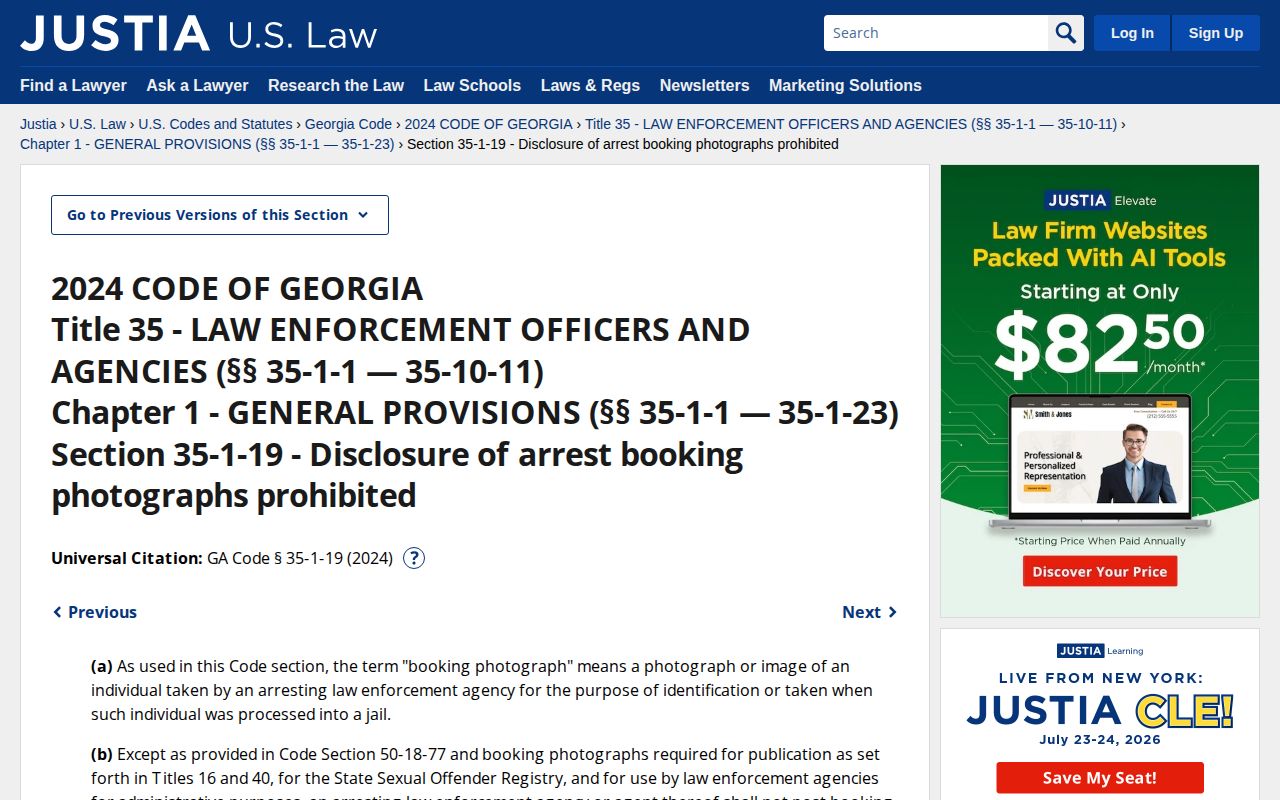
The statute is central to Dade’s request-based photo path because the county does not provide a public photo roster.
No Dade County Photo Roster
The official jail resources page contains a current-inmate heading followed by “Info coming soon.” Research found no separate recent-release page and no online booking-photo gallery. That is a clear absence, not evidence that all booking records are closed. It means a person searching for a Dade County Jail image must use the records process rather than wait for a photo tile to appear.
No Dade County Sheriff mobile app with an inmate lookup, recent-release list, or mugshot feature was found. The sheriff has an official website and a social link, but neither should be described as a release-photo feed. The Dade County 24-hour release route likewise explains the absent official feed and the direct verification choices.
Note: A missing roster photo does not prove that the booking never occurred or that the photograph is unavailable through a lawful request.
Request Dade County Booking Photos
Send the request to the Dade County Sheriff’s Office or Dade County Jail. The jail lists jail@dadesheriff.com, 706-657-2277, and 706-657-3233. Its physical address is 75 Case Avenue, Trenton, GA 30752, and its mailing address is P.O. Box 920, Trenton, GA 30752. Published business hours are Monday through Thursday, 8:00 a.m. to 5:00 p.m., and Friday, 8:00 a.m. to 2:00 p.m., excluding holidays.
- Identify the person by full name and date of birth if known.
- Give the booking date or a narrow date range.
- Ask for the booking and release record plus any releasable booking photograph.
- State that the request is made under the Georgia Open Records Act.
- Ask the custodian to cite the legal basis for any withheld part.
- Keep the response, fee estimate, and released files together.
Georgia’s open-records framework calls for production or a response within three business days when records are not immediately available. The agency may charge lawful copy, search, redaction, and production costs. The Governor’s published model lists ten cents per letter or legal page plus actual media cost and authorized staff time. Ask for an estimate when a request may require extensive work.
Dade County News Arrest Reports
Discover Dade arrest reports provide a local news trail for sheriff bookings. Observed Dade entries are text-focused and include details such as the booking time, name, age, place, charges, and total charges. Research did not establish that the Dade reports publish mugshots. The category also includes material from other counties, so fields visible on another county’s post should not be attributed to Dade.
A news item can help narrow the booking date for an official request. It cannot confirm release. Commercial mugshot and inmate pages may also appear in search results, but no commercial source is linked or endorsed here. Such pages can mix old, incomplete, or generic data. Confirm the arrest image with the sheriff and confirm the case result with the court.
Dade County State Offender Photos
The GDC offender search warns that offender photographs display automatically when available. This channel applies only when the person entered Georgia corrections custody. Search by name, ID or case number, age, and other available identifiers. Then compare the status, conviction county, sentence information, and photograph.
A county jail release to GDC is not a community release. The Dade booking photo and the later GDC photograph may have different dates and purposes. GDC also advises written verification through Inmate Records and Information before its data is treated as complete. Use the state image to identify a state offender record, not as a substitute for the Dade jail’s booking and release file.
Georgia Mugshot Removal Rules
O.C.G.A. § 35-1-19 restricts law-enforcement disclosure of a booking photograph when the image may be placed in a publication or on a website that requires payment to remove or delete it. The rule helps explain why a Dade request is reviewed instead of answered through a public gallery. It does not mean every arrest or release record is sealed.
The Georgia Attorney General’s consumer guidance describes a written removal route for a mugshot website. The request should identify the person’s name, date of birth, arrest date, and arresting agency. It must be sent by certified mail with return receipt or by statutory overnight delivery to the publisher’s registered agent, main business address, or primary residence. Do not pay an unverified removal service or assume removal changes the official record.
Restriction, sealing, and removal are different. A restricted criminal history limits access under Georgia procedure. A site removal takes an image off one publisher. Neither step should be assumed to erase the sheriff’s source record. For a court outcome, request the specific Dade disposition rather than a broad history search.
When requesting correction from an official source, identify the exact image and attach the record that supports the change, such as a corrected identity or a court order. Ask what the office can amend, restrict, or annotate under Georgia law. An agency may preserve the original booking file even when public access changes. For a nonofficial publisher, keep copies of the request, delivery proof, page address, and response. The Attorney General’s process focuses on written notice and proof of delivery. It does not authorize changing the official arrest, court, or release history. Each source must handle its own copy.
A later case outcome should be kept with the image record. Acquittal, dismissal, or release does not change what the booking photograph depicts, but the court disposition supplies vital context.
Dade County’s sheriff-linked sex-offender portal is another image source with a narrow legal purpose. It covers people who have a registration obligation, not all people released from the jail. A registry photograph, address, or status should never be described as a general Dade County released-inmate gallery. Confirm the identity through the registry fields and use the sheriff or court record for the underlying booking and case outcome. If the person has no registration duty, the absence of a registry result says nothing about a past jail photograph.
Photo identity also requires a date check. A GDC offender photograph may have been made after transfer to state custody, while the Dade County booking photo belongs to the earlier local arrest. Compare the name, identifiers, conviction county, booking date, and agency before treating two images as the same record. GDC warns that photographs display automatically when available and advises written verification of offender information. Its search is useful for a person who entered state custody, but it does not prove what image the Dade jail created.
When the requester needs the official Dade image, the open-records request should remain narrow. Name the person, provide the date of birth if known, identify the approximate arrest date, and ask for any releasable photograph from that booking. Request the related booking and release fields at the same time. The release reason, date, holds, and receiving agency give the photo needed context and help prevent a transfer from being mistaken for community release.